Painting animation explorations

Interview with Patrick Jenkins: Paint-on-Glass Animation

Description: The Phantom City Trailer, paint on glass animated film by Patrick Jenkins

Synopsis: A woman with a mysterious suitcase and a man in pursuit... just one of the tales in the Phantom City. A magic realist detective story. © Patrick Jenkins 2015

Medium and Materials

Q) What medium do you use for painting animation?

A) I use gouache paint mixed with glycerin and water. Traditionally paint on glass animators have used linseed oil and oil paint mixture. Those mediums have a strong odor that can affect you over time, especially in an area that isn't properly ventilated. An animator friend of mine did this years ago and he lost some of his sense of smell from being that close to oil paint all the time. So I use a mixture of gouache, glycerin, and water.

Q) What's the ratio of gouache to glycerin that you typically use?

A) I don't have a specific ratio of gouache to glycerin. I do it more by feel. For instance, if the mixture is too runny, I add more gouache. If it's drying, I add more glycerin, etc. The glycerin prevents the gouache from drying, keeping it pliable for changing the animated imagery.

Q) Do you work on glass?

A) Technically I work on formica covered boards. Formica is a very smooth surface that's used on kitchen countertops. But the approach is called paint on glass. With paint on glass, you have to repaint the character every time, removing some of the previous image, altering it, and taking a photograph of it with a camera, etc.. Unlike cutout animation where you use the puppets, in paint on glass animation, you have to redo the imagery on every frame. It's almost like classical animation on paper, except there's no paper. You can see the previous painting, but you're repainting it. You just hope you have it right.

But don't forget, you can also take a shot and then look at it on the computer screen and go back and forth between the old and the new images. You can eliminate ones that you don't like. You have to get it right before you move on to the next shot. Sometimes I would tweak it a bit, depending on what it looked like on the screen.

The Black Box Setup

Q) Can you explain your black box setup? (capturing frames in a controlled light setup)

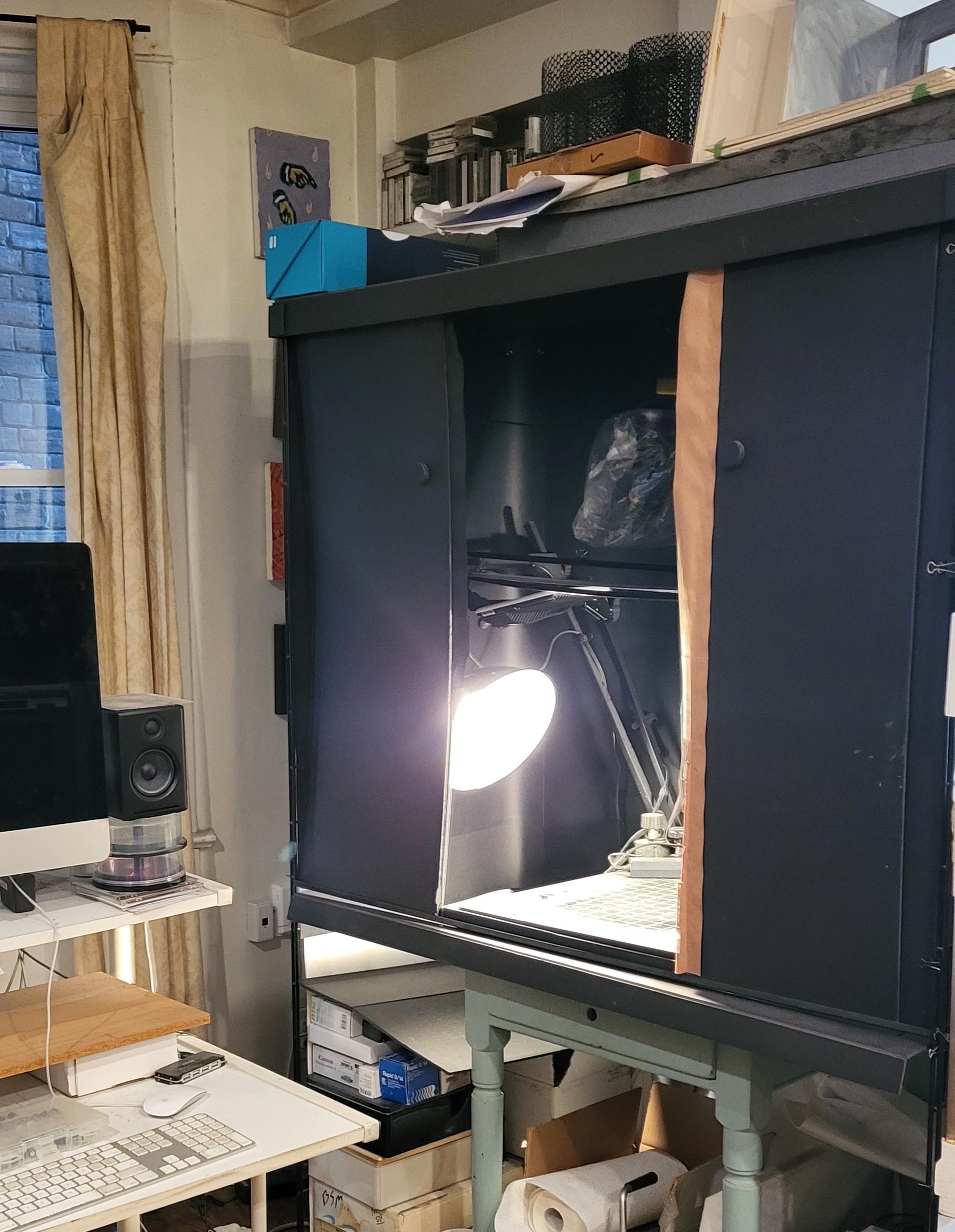
A) The reason for the black box was just so I didn't have to be in the dark when I capture animation frames. The animation stand and the lights are in this closet. I put the artwork inside under the camera and close the door when I take a shot. The camera is elevated, pointing down at the artwork. I would take the painting out to alter it.

Q) What materials did you use to build your black box?

A) The black box has a grid wall and metal frame. The walls are made of foam core.

Q) Do you paint with the glass outside the black box, then place it inside just for capturing digitally?

A) Yes, the artwork is done on a white or black board with peg holes on the back. When I want to take a shot of the artwork, I place it on registration pegs on the animation stand so everything lines up and it is always in the same place when the artwork is photographed.

Patrick Jenkins Painting Animation

Lighting Challenges

Q) What lighting issues did you encounter?

A) There are two problems with lighting. It has to be very consistent. First, there's the electricity that comes into the house, it's always changing. The voltage is going up and down. It's not changing wildly until, for instance, you get the summer when it's hot and everybody throws their air conditioners on. The light levels start dropping or fluctuating as power demand surges. It can be hard to keep the lights levels consistent which causes flicker in the final movie. You find, "Wait a minute, I've got flicker, these frames have different light intensities."

Q) What about the camera itself? Why did you need to use an old manual lens on your digital camera?

A) The second thing is the digital SLR camera. When I started doing this, I bought a camera with a lens ..great, I thought I'm all set up. Put it on manual, set all my F-stop and my shutter speed. I took some shots, and I played them back, and they were flickering. I thought, "Well, what's that?"

In the old type of analogue film cameras, SLR (single lens reflex), when you set your F-stop, it was on the lens and it was locked in. There was nothing that could change in the setting. With the digital SLRs, it shows you the brightest image even when you're in manual, and the camera is actually controlling the F-stop.

So what happens when you take the shot? It zips down to say 5.6, but it doesn't hit it perfectly each time. It hits it really close, but for animation purposes, it's wavering. It's a very small amount of difference in the exposure, but when you play the movie back, the flicker drives you nuts.

I ended up having to get an adapter ring and buy an old manual lens and stick it on the digital camera so that I could override that.

Q) Have you thought about using LED lights versus incandescent? What made you decide between LED and tungsten lighting?

A) I bought LEDs because tungsten lights get very hot, especially in the summer. It can warm up the place quickly. So I thought it would be nice to have cool LED lights for working, instead of those hot lights. However I was happy how the artwork looked illuminated by the LED lights. It was sort of flattening the colors, so I stayed with tungsten.

Both tungsten or LED lights can be used. I did my last film with tungsten, the same as all my films. LED lights should work fine. Maybe in a future project I'll use them. I use two tungsten bulbs in my setup, positioned at 45-degree angles to the artwork.
Q) How did you solve the electricity fluctuation problem?

A) Yes, power fluctuations are possible. Yes, I use an APC surge protector.


Color Palette and Workflow

Q) What's your approach to color?

A) I would definitely limit the number of colors. When you have too many colors at the same time, it's difficult to animate them all. I use three colors max., for simplicity. When there's too many colours they can turn muddy and mix. It's hard to track everything if you start piling in the colors. I restrict myself to 3 colors, as each color has to be repainted each shot. It keeps it simpler for me. It's a personal choice.

Q) Any other color tips?

A) Another thing is to use the same paint colour and brand for the whole film. There is even a wide selection of black paints. They've got ivory black, charcoal black, ..etc, and they're all different. They're not the same. Some of them are more brown, some more blue, etc.

Also, have a lot of paint because certain colors or brands might be discontinued before you finish your film. I was using a color and ran out of it, went to the art store only to find they'd discontinued that brand in Canada. I ended up having to order it from Edmonton, they had a couple of old tubes still in stock.


Technical Process

Q) How do you handle color temperature and white balance?

A) You can deal with that in the camera. You do a white balance, by putting a piece of white paper, take a shot, and you set the camera settings to that white. You set that first.

Q) How often do you need to set white balance?

A) I do that at the beginning of the filmmaking process. Once the white balance is set, I use it through the whole filmmaking process.

Q) You mentioned certain gouache colors behave differently when mixed with glycerin?

A) With gouache and glycerin, certain colors can be a nightmare. For some reason, I found burnt sienna when mixed with glycerin would start fluctuating chemically and the colour would flicker when filmed. Whatever makes up burnt sienna was interacting with the glycerin. So I would have to do work arounds like masking the colour in the final film, etc.

It may be that glycerin interacts chemically to cause fluctuations in certain colors. I have no scientific explanation for this, but it was something I encountered.


Animation Philosophy

Q) What's your approach to keeping things manageable?

A) At first, keep it simple. You don't want to get too complicated at first to the point where you can barely do anything without it taking a lot of work to animate one frame. Some

I have to keep things simple. It's my aesthetic and it's practical.

What I do is more Zen. Even when I'm drawing my graphic novels, I see how few lines can I use to draw a person? The audience kind of fills in the rest of the image in their mind.

Q) What's your philosophy on how much detail to include?

A) Well, I keep it simple because that's the look I want in my films. I pare down the imagery to what is essential to depict the shot. Also, it allows me to work faster as the imagery is not as detailed. The more detail you have, the more work it will be.

Q) Any advice for testing?

A) When you're starting, do a little test, with two colors. You're just trying to see how it goes, and then take it from there.

Q) Any final tips you'd give to someone starting with paint-on-glass animation?

A) Keep it simple. Ha.

Patrick Jenkins Painting Animation

About Patrick Jenkins

Patrick Jenkins is a multi-media artist who makes graphic novels and paint-on-glass animated films. His first graphic novel "Tales from Phantom City" was published in 2023. His recent stop motion animated film, "Hall of Mirrors" (2023), is currently showing on CBC Television and at CBC Gem online.

Patrick Jenkins is a Canadian artist. You can view his work on Vimeo.